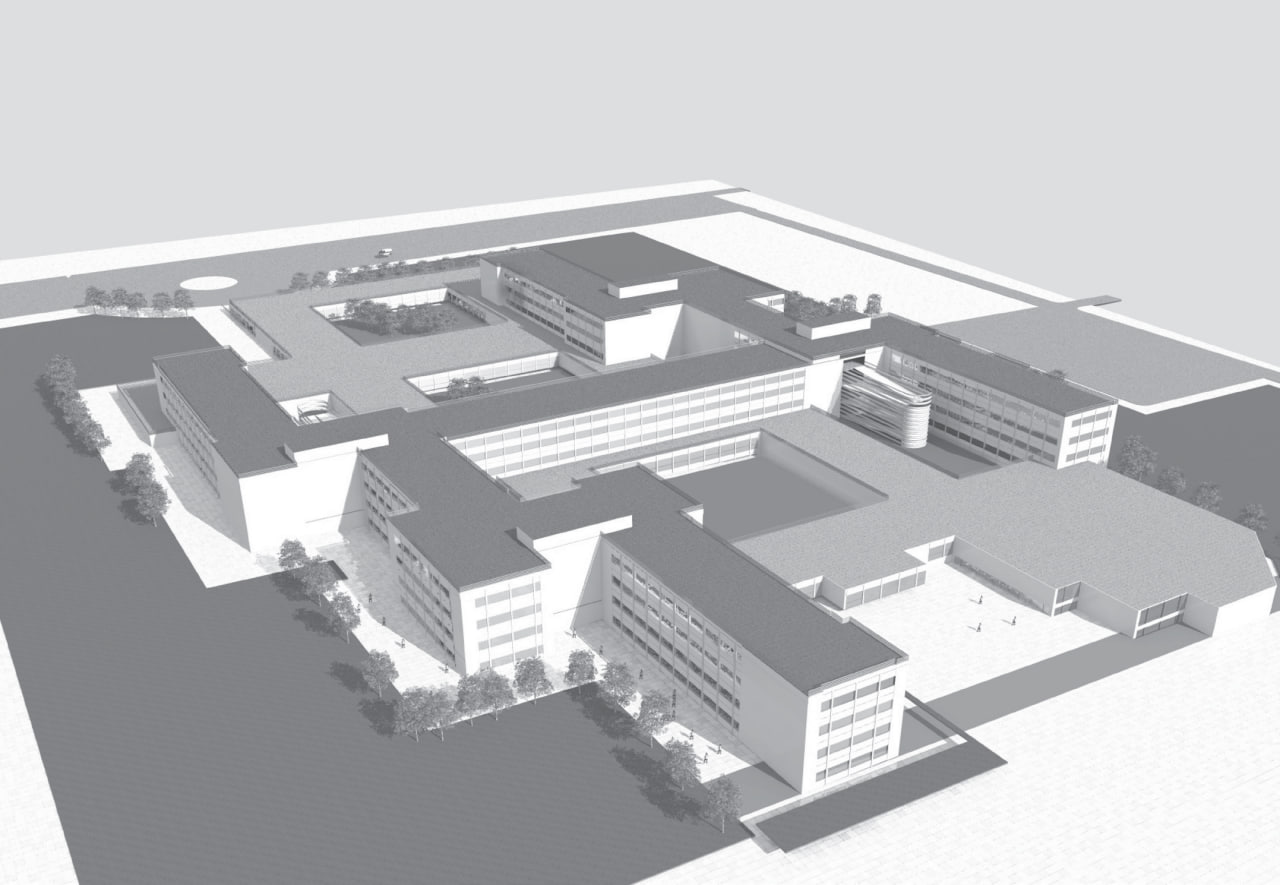
Healthcare · Tertiary Hospital
Specialised healthcare infrastructure serving the medical needs of northern Ethiopia
The Wollo Tertiary Hospital is among the most complex and consequential projects HGC has contributed to — a large-scale tertiary referral hospital designed to deliver the highest level of specialised clinical care to patients from across the Amhara Region and beyond. Hospitals are the most demanding building type in architecture and engineering: they must function twenty-four hours a day, accommodate an extraordinary diversity of users and activities under one roof, respond to stringent infection control requirements, and remain operational even when individual systems fail.
A tertiary hospital is not a single building — it is a small city. Outpatient clinics, inpatient wards, operating theatres, intensive care units, diagnostic imaging suites, laboratories, pharmacy, mortuary, catering, laundry, plant rooms, and administrative offices must all coexist within a coordinated architectural and engineering framework. The relationships between these departments — who needs to be close to whom, which departments generate noise or infection risk, how patients and staff and supplies move through the building without conflict — are the primary design problem that must be resolved before any consideration of form or appearance.
HGC worked with the client and specialist healthcare planners to establish a functional brief that mapped these relationships systematically. The resulting spatial organisation places high-acuity departments — operating theatres, ICU, emergency — at the core of the ground floor plan for rapid access from all directions, while outpatient clinics with their high footfall are positioned at the building perimeter with separate entrances to avoid congesting the main hospital circulation.
Infection control drove many of the detailed design decisions throughout the project. Ventilation systems for operating theatres, isolation rooms, and intensive care units were designed to maintain positive or negative pressure differentials as required by clinical protocols, with dedicated air handling units for high-risk zones. Surface finishes throughout clinical areas were selected for their cleanability and resistance to the chemical disinfectants used in hospital cleaning regimes. Drainage layouts were coordinated to avoid cross-contamination between clinical and non-clinical zones.
Patient dignity was given equal weight alongside clinical efficiency. Single-bed bays in the inpatient wards allow patients privacy and reduce cross-infection risk. Natural light reaches ward areas through carefully positioned windows that preserve patient privacy from outside. Wayfinding — the system of signage, colour coding, and spatial cues that allows patients and visitors to navigate a large and unfamiliar building — was treated as an integral part of the architectural design rather than an afterthought.
Given the scale and complexity of the project, HGC worked in close collaboration with two other Category I architectural firms, each taking responsibility for defined zones of the hospital campus. HGC led the design of the main hospital block — the largest and most complex element, housing the principal clinical departments — as well as two specialist outpatient clinics. Regular coordination meetings ensured that the work of the three firms was fully integrated at every interface, resulting in a coherent campus rather than a collection of separately designed buildings.